
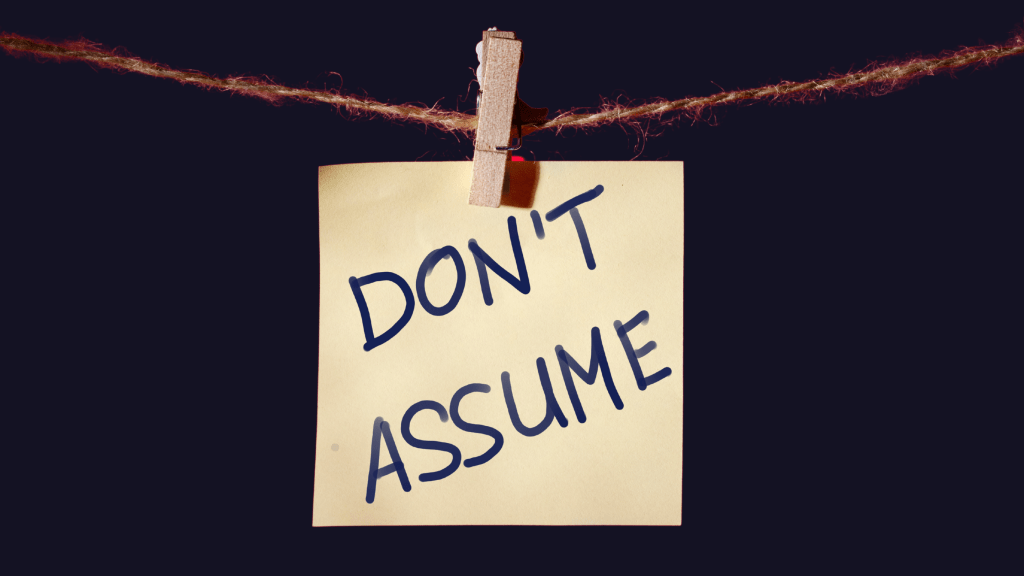
We all do it very often. Every single day, without a second thought, we make assumptions. One after the other. We form opinions about people based on their outlook, what they say (or do not say), and how they act and react (or choose not to).
Yet, isn’t it curious how frustrating we find it when others make assumptions about us? We all think that those people are likely missing the full picture and that they misunderstand us.
I am like you. I sometimes catch myself making assumptions. It seems an ingrained human disposition—like it’s part of human nature. Now, as an adult, I am far more conscious of making assumptions, mostly because I recognise others are likely doing the same about me. Though what others assume about me is certainly none of my business, managing my own assumptions about others is.
Why? Because these assumptions often lead us to believe we accurately understand someone when, most of the time, we are wide of the mark.
Why Do Our Brains Jump to Conclusions?
It’s not always our own fault. It’s how we are designed. Our brains are, in some ways, designed for assumption. They are efficiency-seeking machines, constantly looking for patterns and creating “mental models”. This allows us to navigate familiar paths or routines, such as our daily commute, to free up mental capacity for other tasks.
In addition, many assumptions are learnt behaviours, absorbed from our socio-cultural environment, our families, and the beliefs we had during our earlier years. We might unconsciously adopt our parents’ assumptions about what we deserve, or how relationships should function, even when we consciously question their views later in life.
And guess what? We don’t see things as they are; we see things as we are. Our assumptions about others’ lives are filtered through the lens of our own experiences. We project our personal encounters onto situations, believing that our interpretation is correct because our own experiences feel undeniably true.
We also tend to look for evidence in others that confirms our pre-existing beliefs about the world. However, this can be particularly challenging when we encounter someone with a vastly different belief system, where we often default to an assumption—however illogical—that others are fundamentally like us.
Costs of Assuming
Constantly assuming can substantially damage our capacity to relate to others. If we are assuming we know what others think and feel, we stop truly listening and communicating. Others may feel misunderstood, trapped, or misrepresented, causing friction in relationships at home, work, and elsewhere.
Making too many assumptions also acts as a notable barrier to progress and creativity. They block possibilities. Most critically, assumptions often fuel spirals of negative thinking, involving doubt and black-and-white perspectives, which can trigger recurring cycles of feeling disconnected, awful, and even furious.
Final Thoughts
The good news is that we can learn how to better manage this human disposition. It requires constant conscious effort and a willingness to shift our perspective. The golden rule is that we should embrace uncertainty. Many assumptions stem from our inner desire to control situations, based on our underlying belief that the world is unsafe. As long as we can relinquish the need for absolute certainty, we can dissolve a multitude of assumptions at once.
Also, when we do ask questions and seek truth, we should be prepared to hear things that we do not necessarily agree with or that challenge our perspective. Keeping an open mind allows us to understand that it is fine for others to see the world differently from us.
Challenging our assumptions is not always easy, but it is profoundly rewarding. We should open ourselves up to a richer, more nuanced understanding of life.
Thanks for reading my takes on personal growth. If you would like to learn more about (mental) health, personal development and/or (online) education from me, please feel free to subscribe to my newsletter below. Also please feel free to browse my blog — Society & Growth — for more content at https://jasonhungofficialblog.com/.





 Society & Growth
Leave a comment