

We are halfway through the 2020s. Formal, on-campus education is far from being the only option. Online higher education (online degrees) is no longer a niche alternative. For many, it is rapidly expanding to become an established norm. In the years and decades to come, online degrees will only become increasingly important and valued.
With the presence of e-learning platforms (such as Canvas), virtual meeting rooms (such as Zoom and Teams), and open-source learning management systems (such as Moodle), online education (also known as e-learning) has never been so convenient. Employers nowadays also highly value e-learning credentials when hiring employees and professionals.
So, as online education becomes mainstream, do you want to know which are the top online colleges in the United States?
Let’s find out together.
Key Considerations When Choosing Ideal Online Colleges
To choose the “best” online college, we should consider which institutions’ offerings align most closely with our individual needs and aspirations. Of course, we should also consider the reputation (such as rankings) of the online colleges to maximise the impact (or the deliverables) of the educational credentials. An online programme’s accreditation, tuition fees, and flexibility are all key and vital factors that are worth consideration.
- Accreditation
Before committing to any online degree programmes, we must verify that the institution is accredited by a recognised body (in the United States, this would be an organisation recognised by the Department of Education or the Council for Higher Education Accreditation). These organisations rigorously monitor educational standards and renew accreditation periodically. Information on accreditation can usually be found on the college’s website.
2. Major and Learning Format
Next, we should consider what undergraduate major we would like to choose in order to decide which online colleges are best for us. This can be achieved by reflecting on our passions and which subjects might lead to fulfilling careers, considering potential salary trajectories. Popular degree areas include business, health professions, social sciences, and engineering. Certain engineering fields, for example, boast higher starting salaries. Beyond financial considerations, we should also take our values and passion into account to identify the major we would like to study.
For people with demanding full-time jobs, you may want to choose open-schedule courses that allow students to start anytime and personalise their deadlines (often coming with less peer interaction). Alternatively, fixed-time courses are fully online but require logging in for classes at specific times, which leads to limited flexibility but offers a more structured learning experience.
We may also want to consider online colleges that offer hybrid courses, which blend remote coursework with some mandatory in-person meetings. The upside is that, in doing so, we can experience on-campus learning environments to enrich our bachelor’s studies.
Top Online Colleges in the United States (2025)
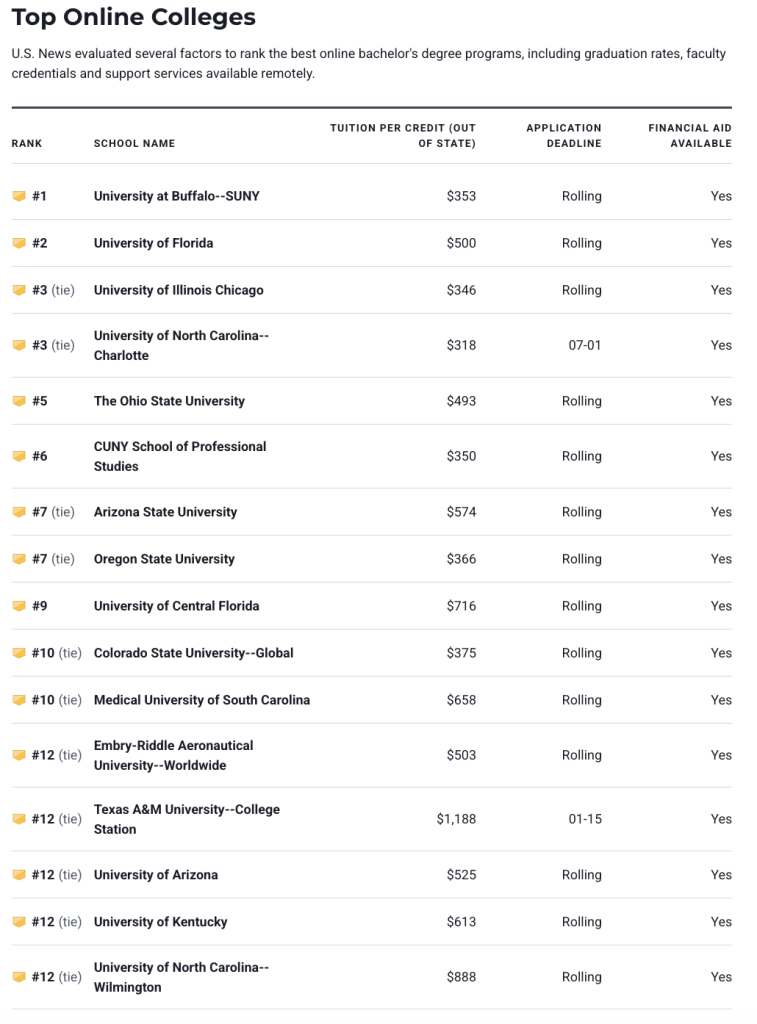
According to U.S. News, the following lists the top 12 best-ranked online colleges in the United States. The University of Buffalo – SUNY tops the list, while the University of Florida and the University of Illinois Chicago rank 2nd and 3rd respectively.
We can see that the majority of online colleges charge a few hundred US dollars per credit, where the costs are significantly lower than what on-campus degree programmes in the United States would normally charge. Moreover, most top-ranked online colleges accept applications all year round. Therefore, applicants can submit their applications at their convenience, enjoying the maximisation of application flexibility.
Application Process
The application process for online degrees is usually very similar to that for on-campus degrees. At the bachelor’s level, first, we have to complete the Common Application (which is accepted by more than 900 universities and colleges in the United States). However, at the master’s level, it is likely that we will need to visit the university’s website directly to check the application process tied to any of their specific programmes.
Second, we may be asked to write essays and submit letters of recommendation. The format and requirements for the submission of essays and letters of recommendation vary across universities and colleges. Therefore, we have to check the application requirements according to the specific guidelines set by the degree programmes and their corresponding institutions.
Third, even for online studies, we may be asked to submit SAT or ACT scores for bachelor’s level studies, and GMAT or GRE scores for postgraduate level studies.
Lastly, it is very likely that we will need to submit our transcripts (depending on the programme’s requirements).
Conclusion
So, if you want lower tuition fees, greater learning independence and flexibility, and the possibility of retaining your current full-time job, studying for an online degree may be your best available choice.
Also, if you already have existing college credits, you may also be able to transfer some or all of your credits to the online programmes you intend to apply for. Therefore, this will shorten your time needed to earn the degree that makes you and your family so proud.
If this sounds tempting, you should go and check out the best online colleges in the United States and their degree programmes.
Thanks for reading my sharing on online degree learning. If you would like to learn more about (mental) health, personal development and/or (online) education from me, please feel free to subscribe to my newsletter below. Also please feel free to browse my blog — Society & Growth — for more content at https://jasonhungofficialblog.com/.




 Society & Growth
Leave a comment