

In mid-2016, Johannes Haushofer, then an Assistant Prof. of Psychology and Public Affairs at Princeton University, shook things up by dropping his unconventional CV on Twitter.
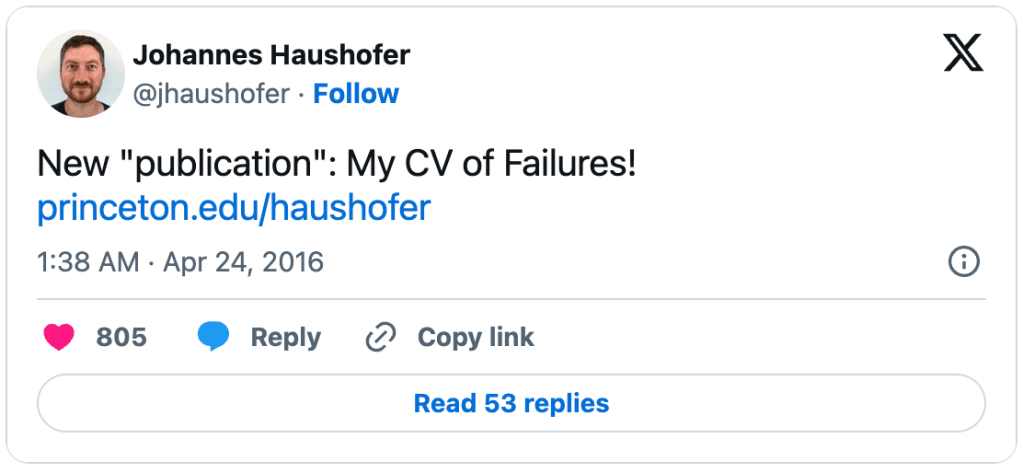
Unlike the usual CVs that highlight achievements and accolades, Haushofer shared his list of degree programmes he didn’t get into, research funding he missed out on, and paper rejections from academic journals. He also included academic positions and fellowships he didn’t snag, and awards and scholarships he didn’t win.
Now a Prof. of Economics and Public Policy at Cornell University, Haushofer wanted to change the academic game by showing that even esteemed figures and so-called high achievers have faced significant setbacks. His goal was to “motivate folks to keep pushing on, even when faced with setbacks.”
“Most of what I try doesn’t pan out, but these failures usually stay hidden, while the wins are out there for all to see,” he wrote.
Haushofer pointed out that people often assume everything works out for high achievers. This misconception can lead to unhealthy outcomes, where people blame themselves for their failures instead of realising that the world is unpredictable, applications are a gamble, and selection committees and referees have off days.
The idea of sharing CVs of failures came from Melanie Stefan, a Professor of Physiology at Medical School Berlin, who first published “A CV of Failures” in Nature in 2010 as a former academic at the University of Edinburgh.
Successes should be celebrated—they inspire those chasing dreams. But recognising successes should drive dreamers to work harder, not become a barrier to progress.
Sometimes, the way we present ourselves professionally (like on LinkedIn) or socially (like on Instagram) is unhealthy. Not only because we might be faking it, but also because we risk demotivating others if we only show our highs. The more we achieve and join elite and exclusive circles, the more we need to be mindful of this.
When we place ourselves in exclusive circles, we might inadvertently discourage others from aiming high because they can’t see a path to their dreams.
Successes should be shared honestly and transparently, and so should failures. Failures are no shame—they’re part of the journey to success. In academia and beyond, we should be open about both successes and setbacks.
“Learn to fall before you learn to fly.”



 Society & Growth
Leave a comment